

How I Nearly Got Rich by Changing the Sex of Fish
Yes, you read that right. It is possible to alter the sex of fish.
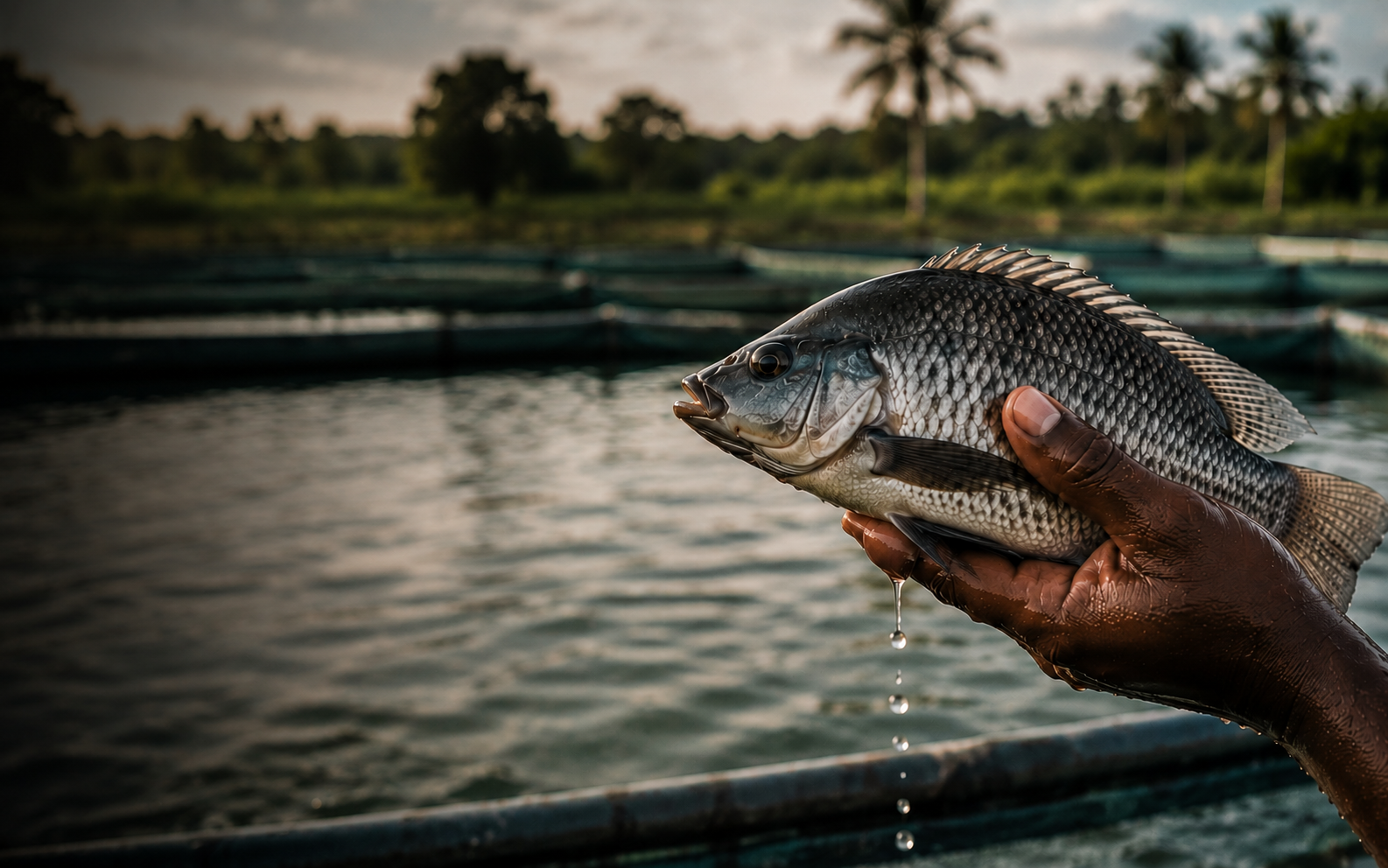
Yes, you read that right. It is possible to alter the sex of fish. Not to play God, but for economic purposes. And in my pursuit of money, I have gone to great lengths. I found myself researching hormones capable of turning female tilapia into males to achieve an all-male population. Perfectly legal. Slightly insane. At the time, it felt like my way out.
This story begins in my first year at university in a neighboring country. I was pursuing a course in Industrial Psychology, whatever that meant. Even though I was in lecture halls taking in all the knowledge, my mind was elsewhere.
The lecturer was explaining organizational behaviour. I can't remember a single word he said.
I was sitting in the back row with a copy of The Cashflow Quadrant hidden inside my notebook. Every few minutes I'd glance at the lecturer, then go back to Kiyosaki.
By the time I finished the book, something had shifted. A degree no longer felt like a path. It felt like a delay. I became obsessed with finding a shortcut—not because I was lazy, but because I was convinced everyone else was playing the game too slowly.
Back home, the government came up with a novel idea: the Economic Stimulus Program. As an avid consumer of information, this caught my eye. On paper, it sounded like a good plan, and I intended to capitalize on it.
How I would do that was the problem. I went through the plan with a fine-tooth comb, looking for an angle to exploit. After hours of exhausting research, I knew exactly what I would do.
The Cash Flow Quadrant by Robert Kiyosaki forever changed my thought process. In the quadrants were the employee, the entrepreneur, the business owner, and the investor. After reading it, I was determined to be a business owner; remember, I was barely 20 years old.
I fell into the trap of trying to emulate some examples from the West. Many of the business success stories are from people who dropped out of college. What I did not appreciate at the time was that they had spent countless hours honing their skills and had become extremely good at their craft. Monetizing their skills became easier as a result. I had zero skills.
Having to tell my parents that I was leaving university to start a business was not an easy conversation. Education was very important to them, and despite their reluctance, I stood firm, notwithstanding that I had no concrete plan and not a penny at hand. All I had was a dream.
I immersed myself in research and learned everything I could about fish farming. I was particularly drawn to establishing a tilapia hatchery to supply farmers with fingerlings. That is where the real money was.
The government was promoting fish farming, and many farmers were building fish ponds. The supply of fingerlings was the challenge, and that's the loophole I hoped to fill.
There was one problem. Actually, two. Capital to start the business and land to set it up. The traditional way of doing it would be to dig ponds, but that would take up too much space, and harvesting the fingerlings was a hectic affair. There had to be a better and more efficient way.
I had a friend who listened to my wild idea and agreed to partner with me. That partnership came with several benefits. He would put up half of the capital, and on top of that, his folks had a piece of land they could lease to us. For the first time, the idea looked real.
I stumbled upon a fish farming system called R.A.S. (Recirculating Aquaculture System) that solved my space issue. Basically, I would set up the hatchery in a greenhouse.
Somehow, we raised the capital and built the hatchery. Seeing it finally come together felt surreal. Until then, it had only existed in notebooks, sketches, and late-night conversations.
The day we introduced the fish into the tanks, I lingered in the greenhouse long after the work was done. The air was warm and humid. Rows of blue tanks hummed quietly as water circulated through the system. Every few minutes I'd wander over to another tank to watch the fish swim.
My partner and I barely spoke. Now and then we'd catch each other's eye and smile.
We'd actually done it.
Standing there, I wasn't thinking about fish anymore. I was thinking about university.
I remember thinking, "I was right to leave."
It was the happiest moment of my young life.
It didn't last long.
Within days, I was learning that fish farming wasn't about watching fish swim. It was about constantly monitoring water temperature, oxygen, pH, and bacteria inside the biofilters. Every oversight came at a cost.
Our first mistake was overcrowding the tanks. The fish developed an infection and started dying. We reduced the stocking density and spread them across more tanks, but the infection persisted. I had to do something.
I went to the chemist and bought some antibiotics. My thinking was embarrassingly simple: if they worked on humans with bacterial infections, maybe they'd work on fish too. I crushed the tablets, mixed them into the feed and hoped for the best.
A few days later, the fish stopped dying. They became more active and slowly regained their colour.
Having had that close call, the next task was to have them reproduce. Now to the million-dollar question: why alter their sex? Well, it's really simple. The challenge with having female fish is that they reproduce ‘too much’ in a pond.
The net effect is too much competition for food due to the larger population, and growth slows. For a farmer who wants to rear fish and offload within nine months, that becomes a problem.
One chilly morning, when I was doing my routine rounds, I noticed a wave of small black things swimming in the tanks. Could it be? I peered closer. It was! The damn fish had finally produced fingerlings!
Finally, my decision to drop out of school seemed to have paid off. Or had I celebrated too early?
Now to the crux of the matter: altering the sex of the fish. If the fry were fed a diet containing a synthetic testosterone hormone during the first two weeks after hatching, many genetically female fish would develop as functional males. The result was an almost entirely male population that grew faster and prevented ponds from filling up with thousands of unwanted offspring.
Miss that window, and the opportunity was gone. Hit it at the right time, and you ended up with an almost entirely male population that grew faster and spared farmers the headache of fish breeding uncontrollably in the ponds. It felt weird at first, but the allure of good profit was too much.
The hormone was highly controlled and almost impossible to get locally. Don't ask me how we got it, but we did. We started mixing it with their feed and crossed our fingers it would work. I felt good handling such a complex project barely out of my teens. The future looked very bright.
For about a month, nothing went wrong. However, the good days didn't last. One fatal error we made was starting with the exact amount of capital we needed. It left us with zero wiggle room to deal with contingencies. We used about half a million Kenya Shillings, which was not a small amount in 2010, especially for two young boys.
Then the problems came — one after another, relentless and seemingly endless. The first was mechanical failure. The water pump we used began malfunctioning. With no money to buy another one, we gave it some first aid. The second problem was even more crushing.
A strong wind damaged the greenhouse and ripped up almost half of the roof. That changed many things. We always had to control the greenhouse temperature, but without a full roof, it was no longer in our power.
Next, we ran out of fish feed. Remember, we had no money for contingencies, and we had nowhere to borrow. Getting the capital was a miracle by itself. The dream began slipping away.
We made frantic calls to try to salvage the situation, but it was as if the gods were on leave. The pump finally gave way, making it impossible to recirculate the water and greatly compromising water quality. The biofilter became clogged.
Every visit began the same way. I'd unzip the greenhouse flap hoping something had miraculously changed overnight. Nothing ever had. The torn plastic still flapped in the wind. The pump still coughed. The tanks looked emptier than I remembered.
One afternoon I unlocked the greenhouse and walked slowly around the tanks.
Halfway through, it hit me. I wasn't checking on the fish anymore. I was counting how many had died overnight.
There wasn't a defining moment when I declared the business over. No dramatic meeting. No heartfelt handshake between my partner and me. It simply died a slow, stubborn death.
Every morning I would convince myself there was one more thing we could try, one more phone call to make, one more temporary fix to buy us another week. But optimism, I would learn, has a shelf life.
Eventually, the greenhouse became a place I dreaded visiting because every trip confronted me with the same uncomfortable truth: determination alone cannot revive a business that has run out of money.
One day, I left knowing I probably wouldn't come back, and strangely, there was no sense of relief. Just an emptiness that comes from watching a dream quietly slip out of your hands.
Breaking the news to my parents was far more difficult than telling them I wanted to leave university in the first place. They had reluctantly trusted me to chase a dream they did not fully understand, and now I had nothing tangible to show for it except experience.
To their credit, they never said, "We told you so." They didn't have to.
The silence carried enough weight. Looking back, I appreciate that restraint more than any lecture they could have given me. Failure already has a way of humiliating you. It doesn't need an audience piling on.
There are few feelings as gutting as watching on the sidelines as something you have worked so hard for begins to unravel and you can do nothing about it. Self-doubt creeps in, confidence wanes, and you begin questioning what you could have done better.
Looking back, I don't think the greenhouse failed because we were young.
It failed because we believed the business plan ended the day we stocked the tanks.
We never planned for the first disaster.
Business isn't about having enough money to start.
It's about having enough money to survive your first mistake.


0 responses