

From 850 a Shot to 60 a Glass
Success has a way of making expensive habits feel normal — until life changes.
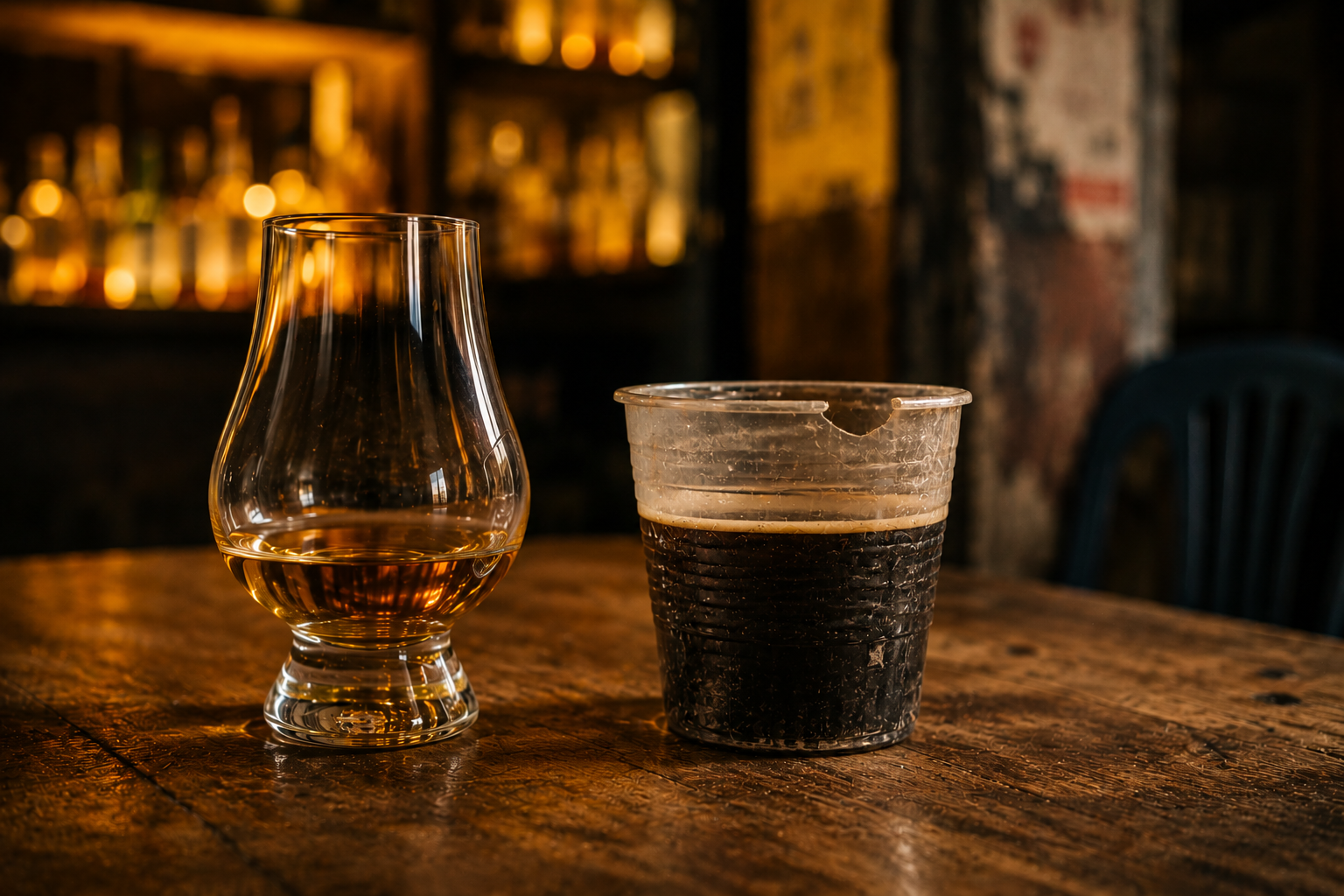
Single malts hit differently. I still remember the first one I ever tasted: Talisker 10. What a beauty. The first sip was as much an experience for my nose as for my palate. As someone tasting a refined whisky for the first time, the aroma surprised me.
It was the first time I had tasted smoke in a drink. Until then, I was used to the harsh sting of vodka distilled from God knows where. Compared to what I was used to, this was serious stuff. Instead of recoiling from the burn, I wanted another sip.
The memory stayed with me, and I promised myself that when I could afford it, Talisker would become my whisky of choice. A few years later, it happened.
My second job paid me a hefty salary. At least it was hefty in 2014. My gross salary was 190,000, so I took home about 130,000. How I landed such a job with no university degree is a story for another day.
That kind of money is dangerous for a young person. More dangerous is what it does to someone without a plan. At the time, I had few responsibilities. My firstborn was still an infant. Life was easy. I decided to revisit my earlier vow to imbibe delectable, fine whiskey.
My workplace was on Ngong Road, and I lived somewhere behind the Junction Mall. There was an upscale joint there I fell in love with. That is where I developed my taste for the finer things in life while slowly draining my finances.
At least three days a week, I would walk there after work, sit on a bar stool, and scan the bottles with excitement. I returned to Talisker like an old friend, but soon enough, my curiosity led me to try something else. Why not? Money was not an obstacle.
I started with the better-known brands like Glenlivet, Glenfiddich, and the superior tiers of Johnny Walker. It is important to note that I was ordering the whisky in shots, but since it was an upscale bar, the shots ranged from 800 KSh to 1200 KSh, or more, depending on the bottle.
I should mention that I had acquired a whisky bible. Yes, such a thing exists. It's called Jim Murray's Whisky Bible, which he releases every year. It contained tasting notes and rankings of hundreds of whiskies from around the world. I would read it at home, then go and try out his recommendations. Oh, the folly of youth!
On every visit, I tried at least three or four different whiskies. That was about KSh 3,000 in an hour. Three times a week, that is nearly 10,000. In a month, I shudder at doing that math.
My palate became more adventurous, and I started exploring more delicate whiskies like Lagavulin 16, Caol Ila, Dalwhinnie, and, of course, Macallan—the Rolls-Royce of whisky.
Interestingly, I never drank to get drunk. I enjoyed the experience itself. I also never showed off. I usually drank alone at the counter, simply appreciating the whisky. Looking back, I think I was possessed.
All this time, I had a family, and things at home were not as smooth. We'll talk about that in other pieces; today it's about alcohol.
Then everything changed. My job did not last long. After about a year, following a series of events, I resigned. It was one of the first major shocks of my adult life. The danger of living in a bubble is believing things will always stay the same.
Every time I write these stories, I do not know whether to laugh or cry at my mistakes. I am amazed by how irrational and reckless my younger self was. Remember how much I told you I earned? Guess how much I saved for a rainy day? You are right. Nothing.
I had spent months developing an expensive taste but not five minutes developing financial discipline. When the salary disappeared, so did the illusion I had created. From then on, it was all downhill.
Sudden change is painful. You have to decide what stays and what goes. Essentially, your priorities have to be thoroughly scrutinised. Excess spending has to go. No excuses. No ifs or buts.
We made radical changes to align with our new reality, and obviously one of them was my drinking habits. Luckily, I was not addicted, and I was not drinking heavily, so I did not experience withdrawal. I missed the whisky experience, but I needed something cheaper for those difficult days.
When I needed to unwind after a tiring day of sending applications and taking psychometric tests online, I went to the local. We had moved from my previous house because the rent was too high for a jobless person, and we were now living in a much humbler abode. The nearest local was the kind frequented by older men, recounting their youth over jugs of alcohol. Yes, jugs. Not shots or bottles.
There was no ambience. The room was lit by two dim fluorescent tubes; one flickered on and off as if it was struggling to stay alive. There were no bar stools, and you had to look for an inch to sit on wooden benches that sat about six men.
No warm smiles from the servers, just nods and grunts as they took your order. No delicate presentation of your drink and glass when it came, just a loud thud as they put your jug and glass on the table. Sometimes the contents of the jug would spill onto the table due to handling, but there was no manager to complain to.
Luckily, I can fit in almost anywhere. As I settled in, I noticed something. Everyone seemed happy. They shared stories and laughed loudly, a stark contrast to the high-class bars I had been used to. There, conversations were few and shallow. This place had more joy.
Keg beer was a serious downgrade. No tasting notes. No lingering finish. No hidden aromas. Just a bitter, frothy liquid that at first tasted like flat beer. It was simply beer with added carbon dioxide.
Drinking Talisker after keg beer was like driving an AMG Mercedes after an old Datsun 110.
I noticed something curious: people drank it through straws. Later, I learned it had nothing to do with taste and everything to do with hygiene. The plastic cups were chipped around the edges, and nobody trusted that they had been washed properly. A straw kept your lips away from years of other people's germs.
Initially, I struggled with the taste, but after the first glass I realised my taste buds were none the wiser, and I would initiate cruise mode. I was a quick learner. That was where I finally understood the saying ‘alcohol has no equal, but makes us equal”
After a few visits, I fit right in. With less money, the economics of keg beer favoured me. A cup was Ksh 60, and a jug had about 4 cups. Three cups were enough for me. So in total, my bill would amount to Ksh 180. That was about 15% of what I used to pay for whiskey. Due to my new frugal measures, this was a very welcome relief. Funny enough, the keg beer started tasting better.
My life did not solely revolve around drinking, far from it. I spent hours poring over job websites and sending job applications to any job that remotely fit my experience. Looking for a job is a full-time job, and it usually left me mentally exhausted.
I must have sent my CV to hundreds of companies, many of which I suspect ended up in the trash bin, as it often happens. I kept on applying until there were no more jobs to apply to. The hard part had now begun: waiting.
Losing my income changed my relationship. Forget about the usual things that are trumpeted like trust, honesty, and the like; remove marriage and see what happens. My relationship struggled: intimacy became a rumour, the conversations were reduced to the bare minimum, and we became strangers. The pressure to provide became too much.
It reached a point where I contemplated other sources of income, such as a business. But a business needs capital, something that I obviously did not have. I liked business, but employment had changed my mindset. I had become addicted to the monthly paycheck, the security, and this made the mental pivot to venturing into business difficult. The certainty that at the end of each month some money would come in had enslaved me.
One by one, the regret letters streamed in. Every time an email notification popped, I just knew it would begin with those familiar words: “We regret…: if only I had saved my money, if only I had invested in something, if only I had empowered my wife to begin a business. Those thoughts rang constantly every time I received a regret email. On the worst day, you know where I went to drown my sorrow, don’t you?
On one of the rare occasions I was invited to an interview, the venue was on Ngong Road, near where I used to work. Memories came rushing back. I could almost taste the whisky in my mouth; that was a bad experience. It’s like seeing your ex with someone else. I did my best in the interview and left in a hurry. I did not want to be around that area.
Back at my now-local joint, I made a few friends and got to know some of the folks who frequented it. It felt like a family. Bonds were formed, and it was so apparent that every once in a while someone would slaughter a goat and bring the meat and soup to the revellers. I was getting too comfortable.
After months of waiting and almost giving up, one email changed my life. It was not a regret letter this time; it was a ‘congratulations’ letter. I finally had a job. The sense of relief was so great that I almost broke down in tears. Almost. I had a salary again. One question now lingered in my mind. Would I resume my expensive whiskey habits or had I learned my lesson?
Months earlier, I would have celebrated with a few shots of Talisker. This time, I found myself wondering whether the man who drank Talisker still existed. I had gone from paying KSh 850 for a shot to KSh 60 for a glass.
Somewhere along that journey, I had changed. The whisky was just whisky. I had another salary. Another chance. The question wasn't whether I could afford Talisker again. It was whether I could afford to become the man I had been before.



0 responses